Sunday, July 15, 2012

Respite, Be Gone

Sometimes you just need a good old-fashioned break from blogging.  Which I what I took this week.
And now I'm back.

I've thought of a slightly more structured format for this daily blog.  Each day, there will be the following features:
- Word of the day (as before)
- Brief news and opinions (as before)
- A brief paragraph celebrating the life of someone born on this day
- Book, Movie, or TV reviews
- A selection for my list of 500 Greatest Performances Ever
- A brief painting (w/analysis)
- Any other columns (Movie Openings, Photographer Bio, weekly NFL predictions, etc.)

Hope you enjoy! 

Word of the day: tetralogy : a series of four connected literary, artistic, or musical works

Well, it's been a nice, enjoyable week.  We've gone to the pool a few times, went to Augusta (where we bought a load of books), and Julia had a beyond-productive week at a writing workshop, where she wrote a huge chunk of her dissertation. 

And that's the key thing, her diss.  She's ready for it to be done with, behind her.  She's ready to defend it and be Dr. Fischer.  Both of us hope she gets the tenured position at GSU (which starts fall, 2013), but secretly we hope she gets other offers in places that aren't Statesboro, Georgia.  And then, as the saying went, see ya, wouldn't want to be ya, Stinksboro!

*


Born today : Rembrandt van Rijn (1506, Leiden - which is, presently, in the Dutch province of South Holland)

Rembrandt, born into a modest family (his father was a miller), set himself up as an independent painter in his hometown.  But his career took off when he moved to Amsterdam in 1531.  Rembrandt had a great career as an artist, teacher, and art dealer, but his life in Amsterdam was marked by tragedy: the death of three of his children, the passing of his wife (at the age of 30!), and eventual bankruptcy.  An auction of all his belongings - weapons, ancient sculpture, Italian Renaissance works, Far Eastern art - couldn't stave off insolvency; he lived a bit too ostentatiously.    

Rembrandt was the greatest of the Dutch artists of Holland's Golden Age.  Although the artist never went abroad, he studied extensively: Italian artists, fellow Dutch artists, Caravaggio, Rubens.  Rembrandt was a master at observation, the practice of directly studying people from life a guiding principle of his.  He was a highly successful portraitist in the 1630s (thanks to works like The Anatomy Lesson of  Dr. Rulp).  His most fertile period ended around 1642, with the group portrait, Night Watch - one of the most famous paintings in the history of the world.  Reputed to be initially met with customer dissatisfaction (at least some falsely claim), the work shows a company of civil guardsmen, eighteen in all, led by Captain Frans Banning Cocq and Lieutenant Willem van Ruytenhurch.  (I won't even begin to go into these paintings; thousands of articles have been written on them - they're easy to find, if you're interested).       

He was an extraordinary draftsman, etcher, and printmaker, with many pupils and assistants.  He would go on to influence many painters from the next two centuries.       


*

Book Reviews
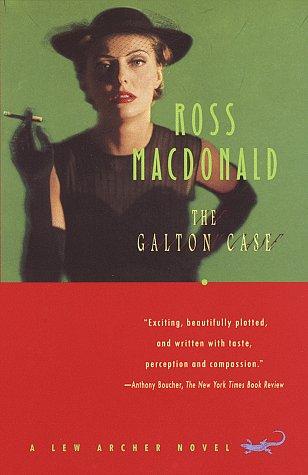


I have been on a bit of a Ross Macdonald kick lately, and for good reason: I've never read him before and have no excuse for it.  If you don't know of him, he was the creator of Lew Archer, the tough Southern California detective (played twice on film by Paul Newman), making his way up and down the Golden State of the 1940s-1960s, solving incredibly complicated noir mysteries.  His real name was Kenneth Millar (his wife was acclaimed mystery novelist Margaret Millar) and he was, and is, considered the next-in-line in the chain of tough, dry, snappy, dark mystery writers of American noir, from Hammett to Chandler and so on.  He was an American-Canadian (California born, Ottawa-raised) who wrote eighteen Archer novels in all, on top of short stories.

1959's The Galton Case, the eighth in the series, sets the tone if you want a proper introduction to the  author: dialogue over action; terse character descriptions; tough, sardonic talk; post-war sleaziness; human weakness; dangerous, sly-eyed women; mysteries unbelievably convoluted; West Coast rot; characters with too much money, just enough Oedipal concerns and too little morals; a past that won't stay there. The plot is almost too sinuous to lay out for you, but it involves Archer embroiled in the decades-old disappearance of the scion of a wealthy family.  The lawyer who hires Archer has an unstable wife and a murder on his hands, so naturally Archer finds a connection between both cases.  It's a strong mystery, with autobiographical elements.   
(***1/2)   

Let me say this about 1964's The Chill.  As I'd heard from critics and other mystery writers, it is without a doubt one of the greatest mysteries of the 20th century.  It's the mind-screw of all time, with a plot so twisty, so labyrinthine, that it nearly defies description.  You either go with it or you don't.  If you do, you'll have a great time.  How Macdonald thought up a plot so elaborate is a mystery itself.  Be warned: It's a book you should almost just go ahead and read in one or two sittings; if you put it down for an extended period of time, you might be lost and disoriented when you pick it back up:  Who is he?  How is she related to him again?

Here goes: A man hires Archer to find his runaway bride.  Archer tracks her down to a local college, where, soon enough, the bride's counselor (and new faculty member) is found murdered.  And then there is a long-ago murder in Illinois somehow related to the new murder, and there's a plum imbroglio of suspects: college deans, a bitter cop, Reno scumbags, a long-absent father among them.  It has to be read to be believed, but it all leads to a stunning revelation on the last page, one of the creepiest, most alarming, most stunning twists I've ever read.
(*****)

Movie Review


A word about Safe House, the new movie starring Denzel Washington and Ryan Reynolds.  Better yet, two words: it stinks.  The first half hour, which like the rest of the film is for no beneficial reason takes place in South Africa, is boring, but I stayed with it, hoping maybe it would get better.  Denzel Washington plays a rogue CIA agent who is taken to an agency safe house manned by Ryan Reynolds.  Bad guys break in, try to kill Denzel, forcing the two movie stars to go on the run.  Blah blah.  The movie makes little to no sense, is loaded with incoherent action scenes that are badly shot and blocked (more of that Bourne Identity crap with shots incapable of running longer than two seconds), features forgettable performances: Denzel continues to not challenge himself;  Reynolds is largely disposable; Vera Farmiga stares at screens and gives us character back stories, an inscrutable, thankless role reminiscent of her part in Source Code.  We fast-forwarded a good half-hour and nothing was missed; the device Denzel has that everyone is willing to kill him for is, depressingly, a list of rogue agents and corrupt higher-ups - how original.  Directed by Daniel Espinosa, the film features some of the worst cinematography I've ever seen.  The damn thing is hell to look at.  It's shot in this murky green, bluish-brown palette that too closely resembles glaucoma - Seaweed Strobe, I call it.
(*)      


*

 
Next up in my list of the 500 Greatest Performances?

I'm not much of a fan of silent-movie acting.  Yes, I recognize how hard it was, but it always seemed too kitschy, theatrical, larger-than-life in a phony way.  Cinema was meant for the close-up, I get and appreciate that, but those old actors always seemed too hammy.  That said, one of the period's most beguiling, touching performances?

    
Janet Gaynor
as The Wife in Sunrise (1927)

Gaynor won an Oscar for her role in one of the eternal silents, a truly great film by F.W. Murnau that bears a repeat viewing or two.  It's an allegorical work about a married farmer (George O'Brien) allured by a striking, slovenly femme fatale from the city (Margaret Livingston), who encourages him to drown his wife.  It's a heartbreaking tempest of moods, as the farmer finds that he cannot carry out the act.  Why?  Because, as played by Gaynor, the woman is too sweet, too simplistically charming, too elemental.  She's also his soulmate.  It's a film with fat themes - doubt, temptation - that plays out in a striking way, thanks in big part to Gaynor's ingratiating work, in which the actress pulls off a remarkable feat: making an independent, strong-willed woman innocent and guileless.  How do you play innocent?  I don't know, but Gaynor does.

*

Today's painting?  Let's stick with Rembrandt:

The Artist in his Studio
c. 1626-1628
oil on canvas
Museum of Fine Arts, Boston        
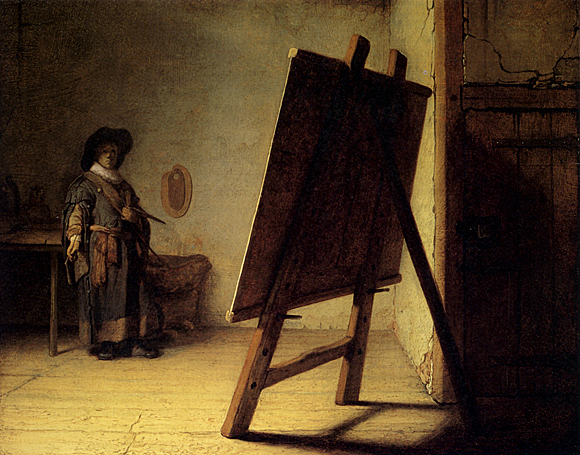


This was one of the first of many self-portraits Rembrandt did of himself in Holland (this one in Leiden).  Rembrandt the artist confronts the toughest stage of the creative process: getting something down on easel.  It's a work of thought, not action.  The use of shadow and light is striking too, as is the perspective, with the artist almost a distant figure, dominated by the size of the easel.  The life of a painter is evoked, but mysteriously so: Rembrandt looks the part, but his work environment is almost comically bare.  There's an air of indecisiveness, uncertainty.  

* 

Tim Walker (#55) is next up in Professional Photographer's list of the 100 Most Influential Photographers of All Time. 

After graduation from college in 1994, the London-based Walker (b. 1970) moved to New York City and became an assistant to Richard Avedon.  Back in England, he did documentary and portrait photography for UK newspapers.  At the age of 25, he did his first photographs for Vogue, where he has been at ever since - the British, Italian, and American editions.  His first major exhibition took place in 2008.  His work is full of romantic motifs and elaborate, extravagant staging; there's something magical and eccentric about his work.


Images:

http://www.thelmagazine.com/binary/82f3/1270128636-sunrisewife2.jpg

https://blogger.googleusercontent.com/img/b/R29vZ2xl/AVvXsEiUevVzaEIdLvtW72N1rpFruvQtLGyyUGE4Tre31x0Vdy4lK-3Br2sDmv9fqdGHDt3NLxa1_nekIcadp2qYjVLIyWpWTGzcNYPaf2rsTZLHrXuDXdT2HkUj6su22XP6nrT6eRddXya06u4/s400/rembrandt015.jpg

https://blogger.googleusercontent.com/img/b/R29vZ2xl/AVvXsEirf_uIw2WGYaByt4NMHQrlojQykrH6T8FvsixLxhn_9GB9mVCj4EP8FIJYM-TOQami6bqAYp1zl3KDxe4GS1IWDgN4XB1MPUoGselds-xhTrJUnirIvQ_pwhGjkbhO6nj0AfGpsse4hcg/s1600/tim+walker+1.jpg

https://blogger.googleusercontent.com/img/b/R29vZ2xl/AVvXsEiefdQ5Ve8wZQUT_-2RReXFdMvfPpvHwS34RdGQzcmlzrY7jkBeXIb214Qy4ha7hCFdpeGAzRYtiRHv9UPKjyVT5miLijF9yyKFi9n2J9174pIG6PsRKBiR_eDL6H7gut8AQtMcLZk_ZpE/s1600/tumblr_l1naw2zKeV1qzdtgxo1_500.jpg

http://farm3.static.flickr.com/2169/2284354424_aa6502d51d_o.jpg

http://www.nga.gov/exhibitions/2005/rembrandt/flash/p11/TileGroup0/1-0-0.jpg

http://bloodymurder.files.wordpress.com/2011/02/n60407.jpg

http://www.vintagelibrary.com/pulp/detect/art/rmacd02.jpg

http://i2.fc-img.com/fc03img/Comcast_CIM_Prod_Fancast_Image/39/894/1323893698869_allmoviephoto-safe_house_001_2x1_Overlay_640_320.jpg

http://hoocher.com/Rembrandt/Rembrandt_The_Artist_In_His_Studio.jpg


Information:

http://www.rembrandtpainting.net/rembrandt_life_and_work.htm

http://www.metmuseum.org/toah/hd/rmbt/hd_rmbt.htm

http://timwalkerphotography.com/biography.php

Tuesday, July 10, 2012

I will not be posting for a while, readers. 

I will return with all new blog posts Sunday, July 15th. 

Sunday, July 8, 2012

Sunday, Grumpy Sunday

Word of the day : bruit : rumor, report; (usually used with about)

Just another hawt Sunday in the south.  Julia and I (and Gabriel) went up to Augusta yesterday in order to take advantage of our favorite bookstore's great Buy 5-Get 5 Free sale. 

Today, Gabriel is taking a nice long nap, I'm doing some yard work, and Julia's upstairs hard at work! 

Book Reviews


R. Tripp Evans' 2010 biography of Grant Wood certainly proved to be illuminating.  I knew next to nothing about Wood's life or art outside of American Gothic, and I thought Evans did a thorough, admirable job at taking the reader through Wood's childhood, influences, family life, teaching career, early work, fame, fall-out, and last years.  It's accessible and never boring - Evans writes lucidly and gives informed, intelligent analyses of Wood's works.  It doesn't take long, however, to realize that Evans has a bit of an agenda - although that may be too strong of a word.  Something's up, though.  Evans is awfully interested in Wood's covert homosexuality.  The author can't seem to ignore it, almost going so far as to claim that homosexuality informed everything in Wood's life: his relationships with his friends and sister; the troubled marriage to his second wife; his fractured teaching career at the University of Iowa; his major works.   I got a little tired of Evans' implications and one-note digging.  So I would recommend this (if you are interested in Wood or American art of the 20th century), but with reservations.  This is as much a Gay Studies book as it an art book. 
(***)


This 2011 young adult thriller by prolific bestselling YA writer Todd Strasser delivers the goods.  It works as a mystery and a suspenseful page-turner.  A high school senior, Shelby, becomes the object of scorn at her school when her father, a well-regarded fashion photographer, is suspected in the disappearance of three young wannabe models.  If her dad is innocent (and he appears to be guilty of something), then, Shelby reasons, that must mean that someone at her dad's office is behind it:  Is it her dad's hunky, dreamboat assistant?  The office manager with a questionable past?  Someone from school possibly?  Everyone is a suspect here, and it's to Strasser's credit that the red herrings don't pop up here so much as evolve naturally from Shelby's growing sense of confusion and uncertainty; you don't feel like the writer is jerking you around, goosing you.  The subject matter gets admirably skeevy and dark, but it has a god twist ending.  I think it would make a solid movie.
(****)       

* 

The Italian Baroque painter Artemesia Gentileschi was born on this date in 1593.  Born in Rome, Artemisia was the daughter of a painter.  She trained under her father, who introduced her to some of the leading Roman artists of the day, including Caravaggio (whose chiaroscuro style influenced Artemesia).  Artemesia never went to school; she didn't learn to read and write until she was an adult.  Artemesia was the plaintiff in a seven-month long rape trial in 1612.  Artemesia, nineteen at the time, claimed that Florentine artist Agostino Tassi cornered her in her bedroom and raped her.  Afterwards, he told her that he would marry her; this promise gained him access to her bedroom time and time again, but he never fulfilled his promise.  He claimed that he she was a whore and insisted that he never had sexual relations with her. 

He was convicted and jailed for a year. 

When the trial (whose transcripts still exist!) ended, Gentileschi afterward soon started work on one of her masterpieces. Judith Slaying Holofernes.  While working on the painting, Gentileschi married another Florentine artist and moved to Florence and had a daughter; she began work on another painting of Judith after the first was finished. 

The first Judith painting shows the Jewish widow Judith in the tent of the Assyrian general Holofernes, whose army had besieged Judith's town of Bethulia.  In the tent, she captivates the general with her beauty, makes sure he is good and drunk and passed out, and then, along with her maid, decapitates him!  She took his head back into town.  Upon seeing it, the inspired townspeople revolted against and defeated the leaderless Assyrians.  Judith, hence, served as a symbol of fighting oppression.  One can't help but see Judith as a stand-in for the artist herself, standing up to (and defeating) her male oppressors.  


Caravaggio painted the same subject, with the same title, in 1598-99.  Like Gentileschi, he chose to portray the actual moment, the act, of the murder.

To see the Gentileschi, you gotta go to the Museo Nazionale di Capodimonte in Naples.

*

My 500 Greatest Performances of All Time pick for today?     


Susan Sarandon
as Sister Helen Prejean in Dead Man Walking (1995) 

After going home empty handed during her four prior nominations, Sarandon finally took home Oscar gold for her beautiful portrayal of the real-life Prejean, who comforts and provides a final friendship to a convicted murderer Matthew Poncelet (a brilliant Sean Penn) in the days before his execution.  Sarandon evokes Prejean's uncertainty and strength in equal measures, and her scenes with Penn really shine.  The final scene, with Sarandon mouthing her love to Penn, is very powerful, but in a way this is largely an interior performance, and Sarandon is as good as any actress (or actor) at conveying a world of emotion and character through her eyes. 


Images: 

http://grantwoodalife.com/templates/grantwood/images/grant-wood-a-life-book.png

https://blogger.googleusercontent.com/img/b/R29vZ2xl/AVvXsEh-LHVMwyeRyg2ByNwUlJnmvsM92s07D1NIaz4DlDpD3mtpeumSE_AqP136A-QaWWQzPrJITvJZzTii0GxD7OwSfWJf-eHeMTM04zyNe8KV5r_PR__RXiu0m1fQsBwQecTWr4HYijaPMwXP/s1600/Artemisia+Gentileschi+Judith+Slaying+Holofernes+Detail+1620.JPG

http://www.foozago.com/indies/media/catalog/product/cache/1/image/9df78eab33525d08d6e5fb8d27136e95/k/i/killyoulast.jpg

http://rudrasofttech.com/rockying/art/susan_sarandon_.jpg


Information: 

http://www.ic.arizona.edu/ic/mcbride/ws200/gentil.htm

http://www.artemisia-gentileschi.com/judith1.html

Friday, July 6, 2012

Hola

Word of the day : toplofty : very superior in air or attitude

Well, not much going on around here, folks.  All the fish we bought a few days ago passed into the great beyond, thanks to a poor filter in the aquarium, which sucked up all our little tetra fish and killed them, forcing us to turn off the filter - hence killing the rest of the fish! 

Pitiful. 

Movie Review

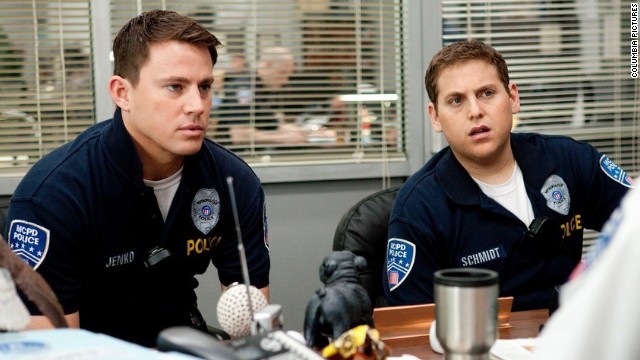
21 Jump Street


I never saw a single episode of the TV show that ran on Fox from 1987 to 1991 and made a star out of Johnny Depp, but that in no way hindered my appreciation of this surprisingly entertaining and funny reboot, with Channing Tatum and Jonah Hill as the young cops who go undercover as high school students to expose a drug ring. 

Because it's a modern comedy, expect a heavy dose of hard humor: penis jokes, gay jokes, F-bombs, penis jokes, gay jokes... and back around again.  It's a wonder that the movie is so funny, but it is.  Tatum, an unexpectedly nimble delight, and Hill make an oddly engaging team - the film has them playing against stereotypes for long stretches, with Tatum the science nerd and Tatum the popular jerk.  The action scenes go on a bit long, but I wasn't really bothered by that.  Johnny Depp and Richard Greico make cameo appearances, and the film has a nice supporting cast, with Dave Franco (James' brother) a stand-out as a drug dealer.  You pretty much know where you stand with this film in the first ten minutes; you'll either immerse yourself in the high-energy spirit of the thing (with Ice Cube foul-mouthing it up as the pair's scowling boss) or you won't.  I did, and I would see it again. 
(***) 

* 

William Faulkner died fifty years ago today.  What can I say?  He was an American master.  When he was good, he was great (The Sound and the Fury, Light in August, As I Lay Dying).  When he was bad, he wasn't readable.  I don't think he has aged that well.  Or maybe it's stream-of-consciousness hasn't aged that well.  But A Rose For Emily is amazing and one of the two best short stories I've ever read - Shirley Jackson's The Demon Lover being the other.

*

Steve Nash to the Lakers?  I'll give that an A-  : not a long-term solution, but it's one of two pieces the Lakers need.

Jason Kidd to the Knicks?  Same grade: A-   :  not long-term (how old is Kidd?  Forty?) but the Knicks need someone to move the ball first, shoot second.

Ray Allen?  It'll be interesting to see where he goes.

Joe Johnson going from the Hawks to the Nets won't equate to that many more wins for the New Jersey... er, Brooklyn Nets unless they can get Dwight Howard.  

*

Book Review 


It took me a while to finally read this book-club fave, and I thoroughly enjoyed it.  I thought at times it was a bit earnest and predictable, but I was really won over by the strength of Ford's period detail, the emotional pull of the Romeo and Juliet storyline, the quietly compelling characters, and Ford's gifts at showing me a time in American history I wasn't at all familiar with.  If you liked David Guterson's Snow Falling on Cedars, you'll probably like this. 

In 1942 Seattle, a young Chinese-American, Henry meets a girl at his English-language school, Keiko, a Japanese-American.  Henry is drawn to her but his nationalistic father considers the Japanese the enemy and forbids Henry from spending time with her.  The Japanese citizens of the city are being rounded up and placed in internment camps, an event that separates the young friends.  Henry stays close with Keiko and her family, visiting and writing her,  but eventually communication dries up.  All that remains of Keiko and her family in their old neighborhood are the belongings they have stored at the Panama Hotel, a majestic building that marks the border between the Japanese and Chinese neighborhoods. 

It's a fairly simple, timeless, love-across-all-obstacles story, crosscutting between the eventful, turbulent scenes set in melting pot WWII Seattle and the present, with the recently-widowed Henry driven by his son (with whom he has a fractured relationship) and son's new girlfriend to try to track down Keiko.  Well-paced and moving, and I give Ford credit for opening my eyes to an oft-forgotten, tragic period in American history.  It's a very easy book to like.   
(****)

*

Let's keep going with my 500 Greatest Performances of All Time:


Kurt Russell 
as Herb Brooks in Miracle (2004)

We've seen inspirational, hard-driving coaches before, played very well (Gene Hackman in Hoosiers to name a great one), but Russell, an often underrated actor, really brings it in Miracle.  As Herb Brooks, the coach who guided the 1980 U.S. Olympic hockey team, who pulled up the upset of all upsets, making us (to quote sportscaster Al Michaels) "believe in miracles" by beating the mighty Russians, Russell provides a grounded, always believable, rock-like presence.  He's not sentimental, and he's so focused, so real, that his emotions, in a strange way, become our emotions: when he gets angry, so do we; when he cheers, so do we; when he doubts, so do we.  Russell never plays emotions, he just is.  He gets a great speech too.

One more:


Gary Cooper
as Marshal Will Kane in High Noon (1952) 

Cooper was a rangier and sturdier actor than you probably remember, aside from being a great, towering, authentic American movie star.  In arguably his finest, most iconic role, he brings a weary, grave, dutiful sense of hard-earned honor to the role of Will Kane, a man abandoned by all his friends and associates - his whole town, really - as he waits for the noon train that will bring his long-lost enemy to town to exact revenge.  Recently married to Grace Kelly's Amy Fowler Kane, who knows deep down that a man has to do what he has to do, Will has everything to lose but wouldn't be able to live with himself if he turned and ran.  It's a great, manly role, and Cooper projects strength and fortitude, but what really grabs your attention is the way in which Cooper (who copped an Oscar for the role) shows how Will is still so nagged by doubt; Cooper isn't afraid to project honest-to-God fear.  You didn't see that much at the time from our western heroes. 


Images: 

http://i2.cdn.turner.com/cnn/dam/assets/120315051956-21-jump-street-still-2-story-top.jpg

https://blogger.googleusercontent.com/img/b/R29vZ2xl/AVvXsEj9FLJf8xEfH4CFusydRYRyYBOfSXhUfwr9q3RsjXSZvmzPtB5Qws6QSEqAjlt1MEdPfz-9rHxqxkoBv_VNNEcVYC07Of5W9Hp-XbUMEW107tMSFxNLZXInaUD_nqPta5OqQxaPrkvP0Jk/s1600/cooper-highnoon.jpg

http://moviesmedia.ign.com/movies/image/miracle-russell-and-team.jpg

http://www.jamieford.com/storage/Hotel%20on%20the%20corner%20of%20bitter%20and%20sweet.jpg?__SQUARESPACE_CACHEVERSION=1227734956138

Wednesday, July 4, 2012

Happy 4th

Word of the day : pandect : a complete code of the laws of a country or system of law
                                            : a treatise covering an entire subject


Having a good Fourth, everyone?  Hope so.  Let's get to the new movies this week: 
(I'm doing this a day early).  

The Amazing Spider-Man    Why?  Why?  Why remake a series that was just rejuvenated ten years ago - with two sequels?  Apparently, it's the first movie (that is, the 2002 film) all over again, with Andrew Garfield replacing Tobey Maguire as Spidey, Emma Stone subbing in for Kirsten Dunst, and Rhys Ifans now in for Willem Dafoe as the Green Lizard or whatever.  The critics like it, but with reservations, of course.  It's not really an improvement, they argue, per se, but it's still well-done.  Directed by Marc Webb, who has one other picture to his credit: 2009's charming 500 Days of Summer.
Verdict:  Mildly Interested 

Savages    Oliver Stone's new film is a bold, wild picture about two southern California young men (Aaron Johnson and Taylor Kitsch) who have gotten exuberantly rich growing pot.  The two even share a girlfriend (Blake Lively).  When the Mexican drug cartel (led by Salma Hayek, recent Oscar nominee Demian Bechir, and Benicio Del Toro) moves in, a turf war begins.  It's reputedly a pulpy, noirish, overlong anti-war-on-drugs, co-starring John Travolta as a DEA agent.  Above average reviews, seen as a return to form for Stone.  Based on the Don Winslow novel, some critics don't like it - calling it bloatedly average and over-the-top, but I guess we'll have to see it to find out.
Verdict: Mildly Interested

The Pact    Director Nicholas McCarthy's first feature is about two grown sisters (Caity Lotz and Agnes Bruckner) who return to their childhood home to pay their respects to their recently diseased mother.  Strange things begin to happen, of course.  Critics say it descends into tropes and cliches, unable to continue to the first half's momentum.  But it has some slyness and some big scares, so I'm curious.
Verdict: Interested    

The Magic of Belle Isle    I liked Rob Reiner's last film, 2010's family feature Flipped.  He returns with another PG-rated drama, with Morgan Freeman as an alcoholic writer of westerns who takes a lakeside cabin for the summer at picturesque Belle Isle, where he befriends a single mother (Virginia Madsen) with three kids (one of whom is played by Flipped's Madeline Carroll).  It's always a pleasure to see Freeman and Madsen, but critics are describing it in ways you could imagine: kind of charming, sentimental, a mushy, minor work, with pretty locations.
Verdict: Interested

*
Neon tetra

Red-eyed tetra
Ghost shrimp

These are the denizens of our new aquarium.  I just hope they live longer than a few weeks!  

*  

Today's entry in my 500 Greatest Performances of All Time:


Robert DeNiro 


as Rupert Pipkin in The King of Comedy (1983)

DeNiro has played a lot of memorable psychos, but second only to Taxi Driver's Travis Bickle was the deluded Rupert Pupkin in the ahead-of-its-time The King of Comedy, one of the more beautifully-extended, oddly endearing, alarming portraits of a nutjob ever committed to film.  Pupkin is a comic who is smaller than small fry, but he wants so badly to hit it big (he lives in his mother's basement, for crying out loud), that he won't take no for an answer; in a grandly absurd, startling bit, he is chased through the offices at CBS, believing that, contrary to what he has been repeatedly told, his idol (Jerry Lewis), really is in the office somewhere.  Finally, along with an equally loony accomplice (Sandra Bernhard, really good), he just decides to go ahead and idnap Lewis.  DeNiro makes Pupkin ridiculous without condescending to him, always a tricky proposal, and he is really funny.  I like the way DeNiro (and director Martin Scorsese and writer Paul Zimmerman) finds infinite variations within a character that verges on the one-note; we should get tired of this crackpot (Pupkin doesn't understand the word 'no' and hears only what he wants to hear), but we don't.  We could watch him forever. 

* 

I haven't forgotten about Professional Photographer's list of the "100 Most Influential Photographers of All Time" list.  We're up to #54. 

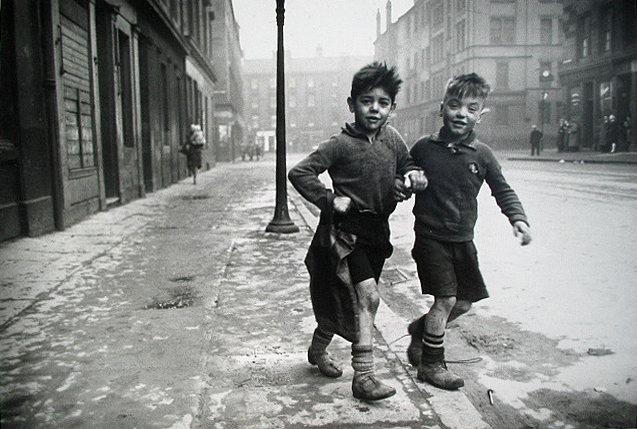
Bert Hardy

Hardy was born in London in 1913 and started work as a lab assistant in a photo agency.  In the late 1930s, when his photographs began getting noticed, he got some further recognition for being one of the first photographers to use a 35mm Leica camera.  He was hired by Tom Hopkinson for Britain's Picture Post and became known for his pictures of London during the Blitz.  Leaving the publication, Hardy was drafted into an army photographic unit, was with the Allied troops during the D-Day landing, and also photographed the liberation of Paris on August 25 in 1944.  He took pictures of concentration camps.  He returned to Picture Post in time to photograph and report on the Korean War (including the decisive Battle of Inchon) and the Vietnam War.  He eventually went back into advertising.  There are three portraits of him in the National Portrait Gallery.

post WWII Glasgow
Korean War
post-Blitz London


Images:

http://i2.listal.com/image/1458363/375full.jpg

http://iconicphotos.files.wordpress.com/2011/08/gorbals.jpg?w=700

http://iconicphotos.files.wordpress.com/2010/06/p_p2.jpg?w=700


http://static.guim.co.uk/sys-images/Observer/Pix/pictures/2010/4/14/1271261998760/neighbours-1950s-001.jpg

https://blogger.googleusercontent.com/img/b/R29vZ2xl/AVvXsEj6tcZ8h9DCs3t-ms_I0lPuu4BLMnqcEmAW2jU4Kv9CgpGERLoh6i73sEXs44RLVCnkSnL8v45t5TRYMU1xkpI8CMglU2XlR5Wwtt4wRbQenHP6rqviwq0p2iMlk_kCY4TKSxpast1_nUY/s400/ghost_shrimp_care.jpg

Information: 

http://www.spartacus.schoolnet.co.uk/USAPhardy.htm

Tuesday, July 3, 2012

Independence Eve

Word of the day : volant : having the wings extended as if in flight (used of a heraldic bird)
                                         : flying or capable of flying
                                         : quick, nimble

Happy holiday eve, readers.  Today, knock on wood, will best be remembered in the Fischer household as the day Gabriel got his first Christmas present of 2012.... an aquarium! 

Because he is obsessed with fish and does nothing but stare at them when we take him to Petco, we have decided to go ahead and bring some more pets into the household. 

More on this to come....

R.I.P...


* 

Because it is a new month, it's time for 10 more entries in Charles' 200 Essential American Films. 
(Due to a busy day, I won't go into detail about the films.)  If you want to see my early selections (1-60), go to this earlier post from last month: 

http://wwwconsideringcjf.blogspot.com/2012/06/new-month.html

The Docks of New York


Here are my selections for July: 

About Schmidt  (2002, Alexander Payne)
The Docks of New York  (1928, Josef von Sternberg)
Driving Miss Daisy  (1989, Bruce Beresford) 
Five Easy Pieces  (1970, Bob Rafelson)
The Godfather, Part II  (1974, Francis Ford Coppola)
The Kids Are Alright  (2010, Lisa Cholodenko) 
The Man Who Shot Liberty Valance  (1962, John Ford)
Notorious  (1946, Alfred Hitchcock)
The Palm Beach Story  (1942, Preston Sturges)  
Sunrise  (1927, F.W. Murnau)

* 

While we're at it, let's add another turn to my 500 Greatest Performances of All Time: 


Jack Nicholson
as Bobby Dupea in Five Easy Pieces (1970) 

You think of this movie, you probably think of Nicholson insulting the waitress, telling her what to do with the chicken salad.  Or maybe you think of his breakdown scene in front of his long-demanding, wheelchair-bound father.  Whatever image or scene is summoned, it's not worth it trying to deny what sort of emotional impact Nicholson's arrogant, misunderstood, lonely, ultimately inexpressive Bobby Dupea has on the viewer.  Bob Rafelson's classic is a profound character study of an alienating man, drifting through life.  Working as an oil rigger, unable to truly love his girlfriend (Karen Black), a disappointment to his family, never figuring out what to do with - or how to cash in on - his remarkable talent at the piano, Dupea seems to be his own worst enemy.  In the devastating final scene, he has no idea how to react to anything. Bracingly hostile and finally, very, very sad, Nicholson's Bobby Dupea is a figure we we will never quite really know how to react to.

*

Today's Author Profile?

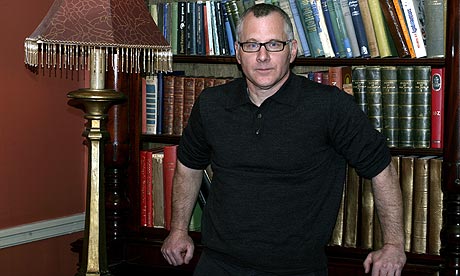
Tom Perrotta 

 
Born: 1961, Garwood, New Jersey

Career:  Perrotta graduated from Yale University in 1983 with a B.A. in English and then received an M.A. in English/Creative Writing from Syracuse University; one of his teachers there was Tobias Wolff (This Boy's Life).  Though he wrote stories for his high school and college literary magazines, his first professionally-published stories were in 1988.  He married his wife, writer Mary Granfield, in 1991.  The couple have two kids and have lived on the east coast for their marriage.  In the mid-1990s, Perrotta taught creative writing at Harvard. 

He wrote a collection of short stories (Bad Haricut: Stories of the Seventies), which came out in 1994, and then had a hard time getting his first novel published; in fact, the movie rights for the novel were bought before the book was even published - of course, this would go on to be Election.  In 1997, his comic novel The Wishbones, about a New Jersey wedding band, came out.

Since the film version of Election, which was director Alexander Payne's first big breakthrough in Hollywood (and featured great performances by Matthew Broderick and Reese Witherspoon), Perrotta's status has risen.  He has written six novels in all, the biggest of which was probably 2004's Little Children, two years later made into the Oscar-nominated film of the same name with Kate Winslet, Jennifer Connelly, Patrick Wilson, and a very creepy Jackie Earle Haley.

Noted Books:  Election, which I haven't read, wasn't as popular as the movie it was based on, but Little Children stood on its own, grandly.  It was a perfect suburban drama/satire about a housewife who has a torrid affair with a local stay-at-home dad, during a summer when a sex offender moves to the neighborhood, an event that brings out the worse in her neighbors.  Perrotta followed it up with 2007's acclaimed, provocative The Abstinence Teacher, a pointed take on this decade's culture wars, with a divorced, opinionated sex ed teacher coming into conflict with her conservative suburban neighbors (while falling in love with a born-again soccer coach).  His latest book, 2011's The Leftovers, is his most ambitious yet.  Again, we're in suburbia, only this time the Rapture has happened.  People just disappeared into thin air and their friends, neighbors, and families have tried to get on with their own lives, never entirely sure that such an event won't happen again.

Why You Should Read Him:  Because he pens good old accessible American suburban satire (sort of Updike-y or Cheever-y without some of the pretentiousness) in comfortable prose.  He writes about suburban problems that plague America as a whole.  His books are scathing but never mean-spirited, and he is almost always funny.  His work has a wide appeal, too.  Plainly put, it's a nice meeting ground between serious literary fiction and palatable, popular fiction.   


Books I'd Recommend:  2000's Joe College (*****), about a Yale student who works at his father's lunch truck in the summer, is one of the best coming-of-age novels you could ever read.  It's the perfect introduction to Perrotta: somewhat autobiographical, quirky, solidly-crafted, with appealing characters, a familiar setting, funny, intelligent.  It's one of my favorite books - in fact, I think it was the very first book of mine I ever let Julia borrow!

Little Children (*****) made a great movie, but the book was something special.  I wasn't as crazy about The Abstinence Teacher (***) because it got a little too political for me, but I would still recommend it, as I would The Leftovers (***), a book that had a bracing premise but then, in my eyes, fell back into a too-familiar groove for Perrotta, with suburban characters I felt I had read about before.


Perrotta's been called the "American Chekhov" by The New York Times for the way he vividly delineates American lives.  His influences include: Kafka, Camus, Conrad, Raymond Carver, Stephen Crane, Hemingway, Wolff.

He co-wrote the screenplay for Little Children with director Todd Field; they were nominated for an Academy Award (but lost out, shamefully, to William Monahan for The Departed).

According to his website, he has written the screenplay for The Abstinence Teacher's film version, but it has long been in-development and there are still no indications that it will be out anytime soon - if at all.  Director Lisa Cholodenko (The Kids Are Alright) is reputedly directing it (yay!) and various reports indicated that at one time Steve Carell and Sandra Bullock were to star.  I don't think that is happening. We'll see.

Read this guy!

Author's Website: http://www.tomperrotta.net/content.php?page=about&n=1&f=2 

*

In the biography of Grant Wood that I'm reading at the moment, I came across a painter I was completely unfamiliar with: John Steuart Curry.  Curry's career mimicked Wood's in the sense that they were both Midwestern farm boys who spent some time in Europe and then were marketed as homegrown American talents, free of European influences and affectations.  The two spent a summer working together at Wood's Stone City Art Colony (outside Cedar Rapids), and Curry and Wood were two of the three painters (Thomas Hart Benton being the other) featured in NYC art dealer Maynard Walker's landmark 1933 exhibition titled American Art Since Whistler.  America, Walker reckoned, needed her own painters.  A new name for this school of painting was coined - Regionalist.  Curry would never gain the fame the other two did, and his work was much more different - if not necessarily in theme - from Wood's, in particular: Unlike Wood's, Curry's paintings were full of storm and action, often featuring athletes, raw violence, politicized evocations of racial injustice and corruption.  His works exhibited a masculine force.  One of his best known paintings, in the collection at the Whitney Museum of art in New York, is 1928's Baptism in Kansas.  


As a satire/creepy portrait of the Midwest, Curry's work - his first major critical success - was received in some of the similar terms as Wood's American Gothic.  Is it a portrait of down home reverence and understanding?  Or a take on religious fanaticism?  

An adult baptism takes places in the open air of a barnyard in front of a group of humble, earnest, suitably-dressed observers.  The subject itself is matter-of-fact, and Curry himself denied the satire of the scene (he was inspired by a recollection of a baptism he observed in 1915), but critics and even fellow Kansas-ers felt that it was a bit of freak show.  Something indeed just seems off.  Curry had recently returned from Europe and was inspired by the Louvre's collection of Rubens, Delacroix, and David, masters who could take great history paintings and infused them with the issues of their time.  That didn't necessarily mean people had any idea what to do with something like Baptism.  For people on the east coast, their reactions were akin to: So this is how they baptize people out there?    

As one of the Big Three of American Regionalist painting, Curry might be worth a second look.  


Images taken from: 

http://sensesofcinema.com/wp-content/uploads/2012/03/The-Docks-of-New-York.jpg

https://blogger.googleusercontent.com/img/b/R29vZ2xl/AVvXsEhSYFn1f9ACQUomcNuDzIxzWQS41wdTk6xr7BmM5HYsRBhsCR8rWPGAwNT6exO_qVCto0veC2tPQQDrFxnbROju1b_g1UxGRCwyMPEfUzAqnA8mj1zV6EHAbeQYLssFcyClqqunajbtL_o/s1600/five-easy-pieces-screenshot-jack-nicholson-495x-2.png

http://static.guim.co.uk/sys-images/Books/Pix/pictures/2009/2/20/1235146171030/Tom-Perrotta--001.jpg

http://diesel-ebooks-cdn.make-a-store.com/mas_assets/image_cache/1/0/3/b/500x500_1063933_file.jpeg

http://predella.arte.unipi.it/predella24/immagini/figure4.jpg


Information: 

http://www.tomperrotta.net/content.php?page=about&n=1&f=2

http://www.johnsteuartcurry.net/JohnSteuartCurry/Essays/Vivian_Kiechel.html

http://www.pbs.org/newshour/bb/entertainment/july-dec98/curry_8-13.html

Sunday, July 1, 2012

July 1

Word of the day : convoke : to call together to a meeting

So... hot... so... very... hot...

Julia and I have just hung out at home this weekend, in the cool, cool air conditioning.  We went out today to take Gabriel to the pet store (where he stared, ecstatically, at the fish) and to Steak N'Shake, where he, ecstatically, ate fries and a milkshake.

Brief Movie Reviews: 


Ramona and Beezus (2011) 

Joey King and Selena Gomez, both adorable, play the title characters in this firm, likable, G-rated adaptation of several of the books in Beverly Cleary's beloved series.  Ramona is always in trouble but means well; she is just hard-headed, curious, klutzy.  Her sister, Beezus, is more dependable, her feet on sturdier ground.  Their daughter (eternally game, likable John Corbett) has lost his job, forcing their mother (Bridget Moynahan) to go back to work.  Aunt Bee (Ginnifer Goodwin) is helpful, always ready for snuggly, sympathetic advice, but she is still hung up on the hunky next door neighbor (Josh Duhamel) who stole her heart back in high school and never gave it back.  With its appealing cast and willingness to deal with some uncomfortable problems that beset some families (losing the house, the passing away of a pet), the film is sturdy and smart.  Adults will like it in the same way they like Kit Kitteridge, that fine film from a few years back with Abigail Breslin and a similarly pearly adult cast.
(***)


The Eagle 

The British novelist Rosemary Sutcliff (1920-1992) was renowned more for her work in children's fiction than she was for her adult historical fiction and non-fiction, and The Eagle of the Ninth, from 1954, was the first in a series of loosely connected books about the Roman Empire.  The Eagle, written for the screen by Jeremy Brock and directed with flair and force by Kevin Macdonald (The Last King of Scotland, State of Play), is a rock-solid, exciting adaptation, filmed in some predictably stunning, expansive landscapes (Hungary and Scotland doubles for England).  The story follows Marcus Flavius Aquila, a Roman centurion whose father disappeared along with the rest of the Ninth Legion somewhere north of Hadrian's Wall when Marcus was a just a boy.  Along with his British slave (Jamie Bell, all grown up from Billy Elliott), a grown-up, imposing Marcus sets off to the north to find out what happened to his father's legion and to retrieve the metal eagle standard, symbol of the Roman Empire.

In the title role, Channing Tatum has a strong physical presence and is deft enough as an actor to give the role gravitas without wallowing in earnestness.  Jamie Bell, as the slave Esca, manages to make his character complex; north of the wall, of course, is Esca's home, and all bets are off, in regards to the pair's master-slave relationship.  Esca's father was killed by Marcus' - can Esca now be trusted?  Donald Sutherland, as Marcus' uncle, has a patrician, slightly fruity decadence.  The fight scenes - mostly involving the north-of-the-wall Seal People (a vicious, painted tribe) - are well-staged and brutal.  It gets off to a slow, so-so-serious start and viewers might wonder why none of the actors have accents (for me, it was better that way, less distracting), but for the fight scenes and the complexity of the characters and the lack of b.s., I would definitely recommend checking this one out.
(***)


Book Review


Colin Cotterill's The Coroner's Lunch (2004), the first in his series of Doctor Siri novels, initially grabbed my attention because of its unique setting: it's 1976 Laos, and the Communistic Pathet Lao party rules the country.  Siri is a 72-year old physician forced into the position of the country's head (and only) coroner.  A barrage of cases come his way - dead bodies left and right - and Siri, with his two assistants (one a saucy female, the other a mentally-handicapped man), has to figure out who among his higher-ups is behind all the intrigue.  The setting is a stand-out and I can honestly say that I learned some stuff from this book.  In truth, I wanted more history, less of the mystery.  Siri is a fairly colorful character (he became a communist because of a girl and views his fellow members' with more sardonic, impudent skepticism than honor or respect) but I could have done without his shamanistic, supernatural visions (the dead come to him in his dreams).  Truth be told, I loved it at first, but lost more and more interest as the story went on and on; because there are multiple mysteries, it got too confusing.  But overall, I thought it was brisk, original enough read.
(***)

*

Let's plow forward with my list of the 500 Greatest Performances of All Time:


Gene Hackman
as Royal Tenenbaum in The Royal Tenenbaums (2001)

I don't like this movie.  Like most of Wes Anderson's work, it has a cute, hermetic whimsy, with almost no emotional connect.  But in the title role, Hackman is nothing short of great; he has a crusty, lived-in, cantankerous spirit, a wily wisdom.  He is a grumbly, playful spirit who loves to mix it up.  Hackman's long absent (from many standpoints) father re-enters his weird family of prodigies and tries to worm his way back into their uniquely strange lives.  The movie has a large, in-sync cast (Bill Murray, Gwyneth Paltrow, Ben Stiller, Owen Wilson) but Hackman (in a role written for him) dominates the proceedings.  Damn if you can ever get a read on him.  You never know what to think of him - he can be crinkly warm one minute, just plain mean the next (especially to Danny Glover's interloper), but what's so special is how you can see how his character traits have been passed down to (and have infected) each of his kids.  His scenes with Anjelica Huston are the best, most moving Anderson has ever done.  I just wished I like the movie before, wished Anderson was more direct, less stylized, not so in love with his style.   


Images:

http://www.zap2it.com/media/photo/2010-07/55119423.jpg

http://www.thecinemasource.com/blog/wp-content/uploads/the_eagle-4-channing_tatum-jamie_bell.jpg

http://avidmysteryreader.files.wordpress.com/2010/11/the-coroners-lunch1.jpg

http://www.breathnaigh.org/.a/6a0134856e869e970c0154342bae27970c-800wi