Thursday, February 2, 2012

Thursday, Thursday!

Word of the day : kegler : a bowler; a person who bowls

TGIT.  Gabriel is ending his first week of school today - his stressful 12-hour week - and we're all looking forward to relaxing the rest of the weekend.  On Friday, we will hang out at home.  Julia will go to Sugar Magnolia for lunch and pick us up a Redbox movie.  Saturday, it's off to Beaufort - bagels, Oops, Bay Street galleries, the park, Five Guys, grocery shopping.  You know where I'll be Super Bowl Sunday late afternoon and evening, and Monday is a big day for Julia. 

This will be my last month of writing briefly (and hopefully, interestingly) about an American masterpiece.  For the months of March and April, I will focus on Mexican masterpieces.  And then May and June, I'll switch to another country.  Today's work of art is a sculpture by Augustus Saint-Gaudens. 

Adams Memorial

You can see the Adams Memorial in Rock Creek Cemetery in Washington D.C. 

Saint-Gaudens was born in mid-19th century Ireland before moving to New York City with his family before he was one year old.  In his late teens, he moved abroad and studied classical art and architecture in Paris and Rome and then moved back to the U.S.  His first major commission as a sculptor was 1881's "Admiral Farragut," which still stands in NYC's Madison Square Park.  Using bronze, the artist was able to fluidly portray the human form; there was no stiffness, just naturalistic modeling.  This would also mark Saint-Gaudens' first collaboration with the architect Stanford White, who designed the granite base; the two would collaborate often and became lifelong friends.  After this work, Saint-Gaudens received numerous commissions, including bronze monuments of Abraham Lincoln, Sherman, Colonel Robert G. Shaw (the character Matthew Broderick played in Glory), and other American heroes; many of these works featured settings designed by White and architect Charles McKim.  Saint-Gaudens began to master various techniques: sculpture-in-the-round, bas-reliefs, relief portraits.

Writer Henry Adams' wife, Clover, committed suicide in 1885 after ingesting the chemicals used in developing photographs.  Adams called upon Saint-Gaudens to create a sculpture of her, a work that would visualize the idea of "nirvana," the state of being free of, beyond suffering.  This work would be ambiguous, the figure neither female or male, cloaked, shrouded, inscrutably expressionless in the face of a great something - be it happiness, transcendence, sadness, grief.  The work was hugely popular and much-visited upon its unveiling, but neither Adams nor Saint-Gauden acknowledged it (despite the location)  as a memorial of everlasting grief.   Adams did study various images from Buddhist and Christian iconography for the memorial, especially the Sibyls in Michelangelo's Sistine Chapel; Adams had studied Buddhism on a trip to Japan in 1886 and had suggested it as a direction for Saint-Gaudens.  Stanford White created the setting for the piece. 

Late in  life, Saint-Gaudens moved to Cornish, New Hampshire and, along with Maxfield Perish, Thomas Dewing and others, founded a community of artists.  He resided there until his death in 1907.

Admiral Farragut

This week's film releases:

- Big Miracle    You've seen the previews.  John Krasinski and Drew Barrymore trying to rescue the whales from the solidifying Arctic Circle ice.  Looks sentimental and sweet, supposedly based on a true story, which usually means the filmmakers have made up or transmogrified 75% of it.  Still, the early reviews are good. 

- The Woman in Black    Daniel Radcliffe is getting notices for his performance in this old-school period chiller about a young lawyer sent to a decrepit Gothic mansion in a remote English village, haunted by the titular specter.  Critics are praising the movie's classic scares and art direction.  Ciaran Hinds and Oscar nominee Janet McTeer co-star.

- The Innkeepers    Another creepfest in thrillers, one with even better reviews.  A star-less (the only big name here is Kelly McGillis - yes, that Kelly McGillis), low-key, well-directed tale about a haunted Connecticut hotel - a real-life place, the Yankee Pedlar Inn.  Two part-time employees bring a video camera and try to document the hauntings of the hotel, which is in its last weekend before closing; there's none of the handheld camera stuff, which is a relief.  It's supposed to be scary and with a great use of place.
 
- W.E.    The Madonna movie.  Critics are having a good time trashing it for its portentousness and silliness, but almost all admit that it looks great.  Remember the character Guy Pearce played in The King's Speech, King Edward VIII?  Remember too, that, he had an American mistress whom he abdicated the throne for (ceding the way for Colin Firth's stutterer)?  This is about Edward and his mistress.  There's present day stuff too, involving Abbie Cornish as a woman fascinated with the long-ago royal couple.               

-  Chronicle   Never heard of this one?  Me neither.  But it too is getting excellent early reviews (what a weekend at the movies!) as a sort-of Cloverfield-meets-Heroes.  Found footage involving three teens who discover they have superpowers.  Sounds generic but the critics like it; the filmmaking is supposed to be dynamic and fresh.  The only cast member I'm at all familiar with is Michael Jordan (no, no, no), recently so superb on Parenthood and Friday Night Lights. 

The Innkeepers

Wednesday, February 1, 2012

New Month

Word of the day : heyday : the period of one's greatest popularity, vigor, or prosperity                   

So... a new month, and that means ten more selections for my list of 200 Essential American Films. 


- Airplane!  (1980, Jim Abrahams, Jerry Zucker, David Zucker)
                    For my money, still the funniest movie ever made.  It's impossible not to crack a smile when Robert Stack enters the picture all serious and removes his sunglasses... only to reveal another pair of sunglasses underneath those.  The dialogue has been quoted so often, it's almost not funny any more, but I'm still gonna smile at a line like "I guess the foot's on the other hand now, isn't it, Kramer?" 


- All About Eve  (1950, Joseph L. Mankiewicz)
                    For all intents and purposes, the Bette Davis Performance.  "Fasten your seatbelts, it's going to a bumpy night!" Backstabbing, envy, romance, cynical wit, put-downs, dialogue so sharp it could slice lard, George Sanders, Thelma Ritter, even a young Marilyn Monroe.


- Annie Hall  (1977, Woody Allen)
                     Okay, so it's no longer my favorite Woody Allen movie, but it' so essential to everything intrinsic about the artist, it would be like acknowledging one's love for Picasso and giving glancing, short thrift to Les Demoiselles d'avignon.  And Allen never had a back-and-forth with anyone as sublimely as he did with Diane Keaton.     

- Fargo  (1996, Joel Coen)
                      Still my favorite Coen brothers movie.  A compendium of their trademark black humor, specific regional observation/caricature, dry-ice performers, shocking violence.  For whatever reason - be it the "yah"s or the woodchipper or Steve Buscemi and Peter Stormare peering into the back door  of William H. Macy's wife as she watches TV- you just remember this movie.  It's almost impossible to only watch it once.  Can the mere mention of any American city - or any city, really - bring to mind, associatively, a movie like this can?  Despite the fact that almost none of the movie has anything to do with the North Dakota city.

- Inglorious Basterds  (2009, Quentin Tarantino)   
                       Christoph Waltz's terrifying, raucously poised turn as Colonel Hans Landa alone would qualify the film for the list.  Tarantino goes for broke here - hell, Hitler and Goebbels die! - and if the movie isn't really that much more than a string of six to eight drum-tight set pieces, what set pieces they are.


- Match Point  (2005, Woody Allen)
                         This'll do as Allen's masterpiece.  The auteur's New York films had long since grown stale, so he moved his neuroses abroad and revitalized his career.  Has there even been a more infuriating, detestable protagonist than Jonathan Rhys Meyer's spineless tennis instructor?  Has Scar Jo even been more intoxicating and sexy?  Allen's instinct for filling out supporting roles with often over-qualified talent hits home here - Emily Mortimer, Matthew Goode, Brian Cox, Penelope Wilton.  The ending is shocking.  But it's the thematic logic, the forceful clarity and depth of Allen's screenplay that is the benchmark.

- Raging Bull  (1980, Martin Scorsese)
                         To a generation of movie watchers who see Robert DeNiro in crud like Meet the Mother Fockin' Fockers or whatever, it's easy to imagine them asking themselves, what's the big deal about that guy?  This.  This is the big deal.

- Reds  (1981, Warren Beatty) 
                         The Russian Revolution as a tearjerker - a smart, layered, moving, Hollywood epic with outrageously good-looking stars (Beatty, Diane Keaton, Jack Nicholson as Eugene O'Neill), Oscar winner Maureen Stapelton as anarchist Emma Goldman, an earthy love story, a clever, affecting use of real-life witnesses to the period.  Stirring and well-shot, with a wonderful climax set at a Moscow train station.


- Strangers on a Train  (1951, Alfred Hitchcock)
                           A marvelous thriller that still holds up, Hitch's film actually improves on the Patricia Highsmith source novel with its brilliant staging, iconic and creepy tour-de-force by Robert Walker as momma's boy Bruno Anthony, signature framing, including a shot at a tennis match in which the other fans turn their heads left to right, following the ball; at first, we don't see Bruno, but as the camera zooms in, we realize he's right in the middle of them, the one figure not following the ball but, rather, staring straight ahead; this was Hitchcock's visual cue that nothing can distract or divert this relentlessly focused, isolated figure.

- Wonder Boys  (2000, Curtis Hanson)
                            A movie that's good - if not better - every time you watch it, Hanson's adaptation of the one Michael Chabon novel I actually made it through has a killer song by Bob Dylan and, as the slovenly, stoned, fumblingly blocked professor Grady Tripp Michael Douglas in his finest performance.  It's a poignant, albeit quirky, singular vision of middle-age sadness and growing old, well-shot around Pittsburgh with a memorable supporting cast (Robert Downey Jr., a particularly exceptional Frances McDormand, a spot-on Tobey Maguire, Rip Torn, Katie Holmes).

Tuesday, January 31, 2012

Stop, Drop, and Rollllllll....

Word of the day : gambol : to skip about in play; frolic, frisk

I recently found one of the best movie websites to visit:

http://blogs.indiewire.com/leonardmaltin/

Maltin is a legend in the field and his reviews aren't pretentious.  They're short, skillfully encapsulating movies in theaters that you've heard of and might want to see.  He also pays dutiful attention to what's going on in film restoration, and there's always good interviews.  This is now a must-site for me.  Usually, on Thursdays or Fridays, I check out new film reviews in Entertainment Weekly or Movieline or NPR, but Maltin's site has now become essential.


Okay, so in two days in school, Gabriel has done well; in fact, his behavior has been classified as "great."  He has had speech therapy, learned to sit for a longer period of time than he hitherto knew how to do, had a fire drill, ate his snacks, taken a half-hour nap, and was walked out to the student pick-up twice by his teacher.  Both days, he has come home slightly dazed/relieved and been subjected to a stress-free, familiar surfeit of Special Agent OSO, peanut butter-and-jelly sandwiches, milk, and snacks.


So in less than two weeks I finished Norman Mailer's massive, imposing The Naked and the Dead, a fanatically-detailed, long-winded, vivid, unsentimental account of a reconnaissance platoon on the fictional South Pacific island of Anopopei.  The Americans land on the island with the goal of driving out the Japanese, who occupy the interior of the island, the enemies' depleted forces strung out beneath the shadows of Mount Anaka.  Mailer traces the interior life of each member of the platoon, even providing "Time Machine" sections where he shows snippets/summaries of each soldier's existence before the war.   At times, I lost track of the characters, forgetting what Mailer revealed about them two or three hundred pages earlier, but by the end, each of their personalities was distinct again, even emblazoned into my conscience.  (It's okay for your mind to drift a while.)

What's most memorable about the novel is how chiefly the notion of anti-climax plays into the proceedings.  Almost nothing in the various missions goes as planned: the battles end before they're supposed to begin; characters deserving comeuppance don't get it; a planned assignment that more or less takes up half the book peters out when the platoon is forced to run form a swarm of hornets; characters die before they've had any closure.  Mailer repeatedly emphasizes abruptness, a lack of physical or moral order, a sense of worthless accomplishments, empty struggle.  In my Shelfari review this morning, I said this about the book (which was inspired by Mailer's own in a cavalry regiment during the Phillipines Campaign in the second World War):  It's "big, extravagantly detailed, emotional, overlong, passionate, lusty, crude, exciting, boring."  I think that's a fair assessment.  There were sections that drug on and one and others that were so emotionally tuned-in, even shattering.  The writing throughout is a knockout and I can well imagine the resulting explosions that scarred the literary scene when this novel came out in 1948, Mailer only twenty-four then, his literary, ambitious, fearless prowess seemingly invincible.  

Finally, every once in a while I swing over to the Georgia Ornithological Society website to see if any rare bird alerts have been posted.  Well, in the month of January, here are (to name a few) of some of the birds that were seen in this great state:

American woodcock
White-winged dove (seen in Savannah)  
Snow Bunting (seen on Tybee Island)
Red phalarope
While it is not uncommon to see all these birds in the state during the winter, it is indeed a sight (I would imagine) and an unexpected treat, perhaps a last chance to see the bird maybe for a few years or more.  If Julia and I end up staying in Georgia, I'll probably eventually join this society as a Fledgling Member, which is a fancy way of saying that I'll only be paying $15 a year. 

Monday, January 30, 2012

Gabriel's First Day of School

Word of the day : Cook's tour : a rapid, cursory survey or review


A poignant, funny day.  Off to school little Gabriel goes.  When he gets home, he'll need a heavy dose of cartoons, snacks, and cuddling. 

"K - as in knife." 

The Hangover 2 is definitely a funny movie, but it's, as you might have heard, pretty much a carbon copy of the first film, only with a different, sultrier locale: Thailand.  Zach Galifianakis is still hilariously zonked-out, loaded with memorable non sequitirs, Ed Helms and Bradley Cooper still do raggedly confused very well, Ken Jeong is still a wild card, and there's even a drug-running monkey.  I enjoyed it, but wondered where the inspiration was this time out.

No real opinions on the SAG awards last night, other than fact that it's detestable that Alec Baldwin has now win six straight years for 30 Rock - my vehement disappointment notwithstanding the fact that I really like Alec Baldwin and his work in 30 Rock.  My question is: Do the voting actors actually watch other comedy shows?  There will no Oscar surprises in the supporting categories - Christopher Plummer and Octavia Spencer are locks - but the Viola Davis-Meryl Streep battle is getting fiercer.  Davis is a brilliant actress, but can the Academy please just end this anybody-but-Meryl charade?  This will be her 13th straight loss; but then, this will the sixth loss for the never-won Glenn Close and another goose egg for Michelle Williams.  And the statuette might just elude Brad Pitt, too, and that's a shame.   

Oh, well, not much today.  Time to get the boy. 
 

Saturday, January 28, 2012

Birthday Eve

Word of the day : bright-line : providing an unambiguous guideline or criterion, especially in law


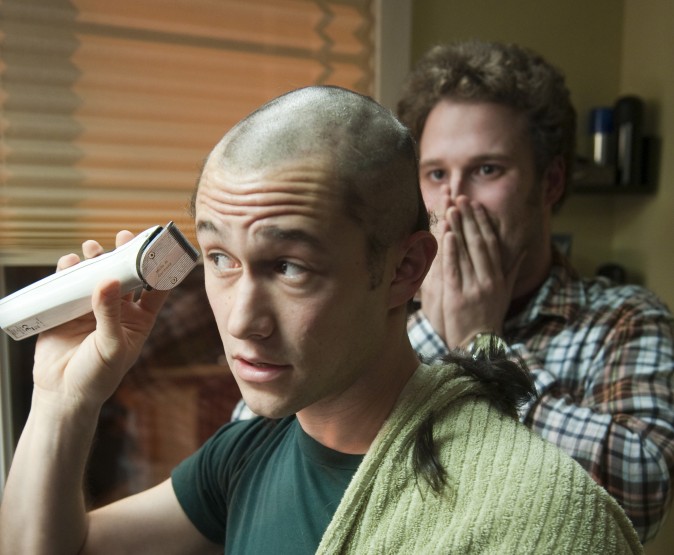
Of all the Oscar snub chatter, I didn't hear too many lamentations for Joseph Gordon-Levitt's unrecognized turn in 50/50, one of 2011's best movies.  And where exactly was the nom for Will Reiser(whose own story provided the basis for the film), the author of the funny-poignant script?  Levitt has been snubbed a few times now (most recently for 2009's 500 Days of Summer); I guess hope lies on the horizon, for the actor has five films/plum roles in the can or in production, including Steven Spielberg's Lincoln biopic and Quentin Tarantino's highly-awaited Django Unchained.  The actor is at his best here, natural, charming, low-key and specific, with glimmers of hope peeking through his bummed-out sadness.  As his best friend, Seth Rogen initially seems like he's going to throw the delicate, nuanced proceedings out of whack with his frat-boy Knocked Up persona, but that's the wonder of the script: every one of the characters, even the ones you're sure you've seen before, surprise you; Rogen's funny as ever, but as the movie rolls along, you begin to look at him differently, in a tender light; Bryce Dallas Howard (who, despite the caricature she was saddled with, was one of The Help's gems) as Levitt's girlfriend, who's not sure if she wants to stick with him through the whole ordeal; Anjelica Huston as Levitt's strong-willed, disappointed but loyal mother; invaluable character actor Philip Baker Hall (possessor of one of the greatest faces in American film) as a fellow cancer patient; and Anna Kendrick as Levitt's twenty-four year old psychiatrist.  Kendrick, with her chipmunk face, is marvelously crisp, a master of the chittery back-and-forth.  The movie, directed by Jonathan Levine, finds humor in dire depths and is a real winner.


So, it's Gabriel's birthday tomorrow.  I love that big guy and I'm so excited he is starting school on Monday.  I know he'll do great.  I'll be sad, but not as much now, because he'll only be gone three hours a day.  That's nothing.  I am looking forward to taking him out tomorrow to Your Pie.  Today, we'll take him out to get his school supplies.  These last six months at home with him have been some of the most enjoyable, relaxing of my life, all thanks to the little guy.    
Happy 3rd, Gabriel Owen Fischer!

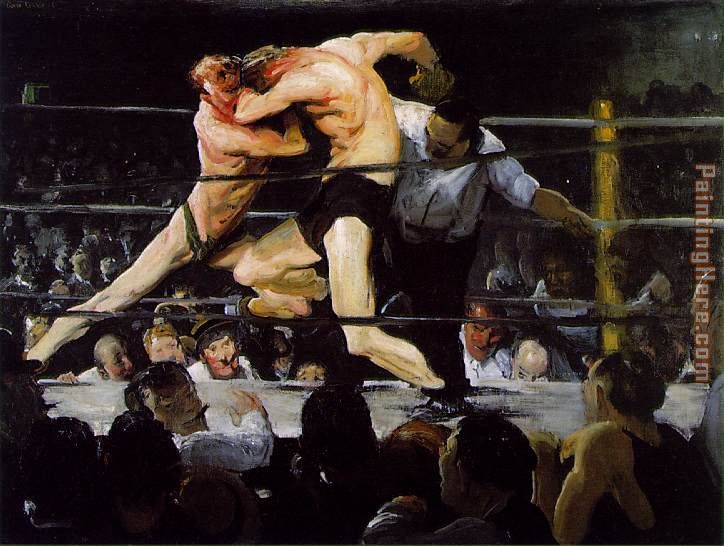
George Bellows, Stag at Sharkey's, 1909
 
And finally, because it's a good sports Saturday - great college basketball games, the Australian Open, the Super Bowl a week away, the Pro Bowl tomorrow night, the NBA in full flush - and I'm reading a good Frank DeFord novel at the moment, it's fine fettle for a good George Bellows painting.  Bellow was of the Ashcan school, a later member of Robert Henri's group of Eight (which I might have mentioned a week or two back), and a former baseball player.  He loved the messiness, the violence, the gritty, sweaty masculinity of the city.  In the early 20th century, prizefighting/boxing was illegal, but athletic clubs - like Sharkey's - did good business, despite being against the law.  The boxers resemble great big horses, poised and graceful, beautifully muscular, full of potential energy; there's something almost classically-sculptured about them, with their pyramidal compositions.  Incidentally, a "stag" is also another term for a prizefight.  Note too the rabid, bloodthirsty fans.  Bellow, who many critics think is in the paintings (the bald man to the right of the referee's right leg) had a studio nearby Sharkey's. 


Thursday, January 26, 2012

Strange southern ways...

Word of the day : intercalate : to insert (as a day) in a calendar; to insert between or among existing levels or layers

Charles Sheeler Church Street El, 1920

So Tuesday I posted a work by and information on Charles Demuth.  It's only fitting, I guess, that I give mention to the other major American practitioner of Precisionism, also named Charles, also Pennsylvania-born.

Sheeler (1883-1965), inspired by Cubism and Fauvism, came home to America from Europe in the early 20th century and began work in photography.  He specialized, focused on architecture, particularly the architecture of the industrial landscape - his works were stylistically realistic but attuned to, guided by an underlying abstraction in their functional patterns.  From 1910 to 1926, Sheeler concerned himself with the rural Pennsylvania town of Doylestown (where he rented a home); his work during this time was important because the elements of his works done during his time in Doylestown  - doors, ladders, windows - are the same elements he'd focus on during his works of the city.  In 1919, he moved to New York and befriended some of the Dadaists.  It was during this period that he created the above painting, a a sweeping, bird's-eye view of Broadway and Wall Street and the elevated Church Street el.  The artist simplified planes and forms, eliminated textures and details, allowing for a geometric interplay of shapes and colors.  

Other career highlights: In 1927, Sheeler was commissioned to photograph the Ford Motor Plant in Dearborn, Michigan.
In the late 1930s, the artist was hired by Fortune magazine to do a series of portraits (paintings) of six power-generating machines, as a tribute and testament to the modern industrial age.

Rolling Power, 1939
It was photography that was the impetus for Sheeler's drawings; there is little thematic difference between his photographs and paintings.  Sheeler often ignored the human element.                                  
Anywho, let's switch subjects.  A new feature: Every Thursday or Friday, I'll mention the movies that are opening up nationwide - or any major, hyped independent or limited-release films opening on the coasts and occasional dribbling out to middle America.

1/27 releases:
- The Grey   Okay, this is a must-see.  Liam Neeson as an oil roughneck whose plane crashes in the Alaskan wilderness, pitting the survivors against a pack of CGI-created wolves.  Good early reviews, which commend a strong human element and great photography. 

- One For the Money  Not screened for critics, which is often a bad sign.  Katherine Heigl is Janet Evanovich's bounty hunter heroine Stephanie Plum, a character the best-selling Evanovich has featured in, to date, eighteen Plum mysteries.  An interesting (read: odd) supporting cast: Debbie Reynolds, John Leguizamo, Sherri Shepherd, among others.   

- Man on a Ledge, a poorly-reviewed action drama with Sam Worthington, Ed Harris, and Elizabeth Banks.  A few comments: "cheap-looking," "preposterous," "too busy."

And finally, today: If I thought I had heard it all, I hadn't.  If Julia and I couldn't wrap our head around the fact that our real estate agent and landlord/previous homeowner insisted that southerners had no use for window screens ("people don't open windows around here"), then imagine our belief-defying incredulity when we hear our neighbor, a cross between Medusa and the Blair Witch, respond to a complaint I raised to her about her dog pooping all over our backyard (and her not cleaning it up) with a "And that bothers you and Julia because...?"

Statesboro!!!

Tuesday, January 24, 2012

Oscar, Oscar, read all about it!

Word of the day : yegg : safecracker, robber

Well, let's get right to it.  The Oscar nominations were announced this morning.  Here's the list: http://www.imdb.com/oscars/nominations/

And here are my thoughts:

                                                                      Demian Bichir

Who?  The Latino actor finds himself alongside Brad Pitt and George Clooney in the Best Actor category.  What a thrill!  He beat out DiCaprio, Gosling, Michael Fassbender, Michael Shannon, among others, for his role in the little-seen A Better Life, director Chris Weitz's (About a Boy) tale of a Mexican immigrant in L.A.  The only work I've ever seen of Bichir's (who mostly does Mexican films) is as Mary Louise Parker's boyfriend in Weeds.  I need to see this, quick!

Of the twenty acting nominees, nine are first-timers, which is about on par as far as that annually goes.  Congrats to the finally-nominated Gary Oldman!

Among the many comments I've read today in regards to the nominations (on The Huffington Post, Entertainment Weekly, Movieline), a consensus is that Albert Brooks was snubbed for Drive, Ryan Gosling was snubbed for all of his 2011 performances, George Clooney is overrated, and Extremely Loud and Incredibly Close is a pile of doodoo.
 
I do think it's strange that the Academy only nominated nine films, instead of ten.  Surely there wasn't one more film they could have thrown in there... With its 48% Rotten Tomatoes review ratings, Extremely Loud and Incredibly Close just many be the most critically-reviled movie ever to be nominated for Best Picture.  But Stephen Daldry movies always get nominated for something, even when they're not that good (Billy Elliott, The Hours). And I'm not at all buying that the Academy yet cares for or appreciates good comedy, despite the bone they threw Melissa McCarthy and the Bridesmaids screenwriters.  Given the chance to nominate the universal hit/critically-acclaimed Bridesmaids for Best Picture or nothing, they chose nothing!


I'm ambivalent on this one.  I like Jonah Hill and think he's funny and even kind-of liked his spooky, pathetic Cyrus.  And I thought Moneyball was terrific.  I like to see an actor change pace, go against type.  I'm not entirely sure this performance was that compelling, though.  It was a flat character and Hill didn't really do anything with it.  He just kind of sat there and stared blankly at Brad Pitt and took forever to say his lines.  Put it to you this way: In this category, you should want your Supporting Actor to steal scenes, to not go away.  You want to miss them when they're not on screen.  I can't say Hill met any of those expectations.

Okay, the Best Original Song category is a joke.  Two nominees!  There were only two good songs this year written for films?  Why even have this category?  Sergio Mendes!  The other guy from Flight of the Conchords for his song in a Muppets movie!  A damn joke!

Two performers who haven't been nominated since 1988 (Max von Sydow, the legendary Swedish actor, and Glenn Close), one who hasn't been nominated for his acting since 1989 (Kenneth Branagh), more late-career Martin Scorsese love, a Spielberg snub, no Joseph Gordon-Levitt or screenplay nomination for 50/50, no Madonna, a second acting nomination for an actress nobody knows (Janet McTeer), and a complete ignoring of the extremely well-received Young Adult, despite past Academy appreciation for Charlize Theron, scribe Diablo Cody, and director Jason Reitman.

Woody Allen's nominations are now at 23, though he hasn't won since his was awarded Best Original Screenplay for 1986's Hannah and Her Sisters. 

Hugo led all films with 11 nominations, followed by The Artist with 10.  My favorite non-nominee response, however, the funniest?
Why, that would be the wonderful Albert Brooks.
Just after the nominations were read this morning, he tweeted the following:

"I got ROBBED.  I don't mean, the Oscars, I mean literally.  My pants and shoes have been stolen..."

A few minutes pass.  And then:

"And to the Academy: 'You don't like me.  You really don't like me.'"

Oh, well.  I'll be back in three or four weeks with my predictions.


Having just finished Anne Tyler's 1982 classic Dinner at the Homesick Restaurant, I can honestly say that Tyler writes perfect books.  I've praised her before on here, but I can't really say enough about her.  So I went hunting for information (in the form of interviews, etc. ) about her and have found very little, due to the fact that she doesn't do book-tours, very, very rarely allows interviews, doesn't lecture or teach, reputedly, has never ever met her longtime editor, and has maintained a swathing cloak of privacy.  Here is what I do know, however:

- she lives in Baltimore, where most of her books are set.  She was born in Minneapolis, the eldest of four, to a chemist father and a social worker mother.  A portion of her childhood was spent in Quaker communities in the mountains of North Carolina.

- she went to Duke University and was married to Iranian psychiatrist Taghi Modarressi for thirty-five years until his death in 1997; they have two daughters.

- she worked as a bibliographer in the library at Duke and worked in the law library at McGill University before moving to Baltimore to write.

- 1988's Breathing Lessons won the Pulitzer Prize and was named best novel of the year by Time Magazine.

I'll have more to say about Tyler, I'm sure, when her novel The Beginner's Goodbye, her 19th, comes out in April.

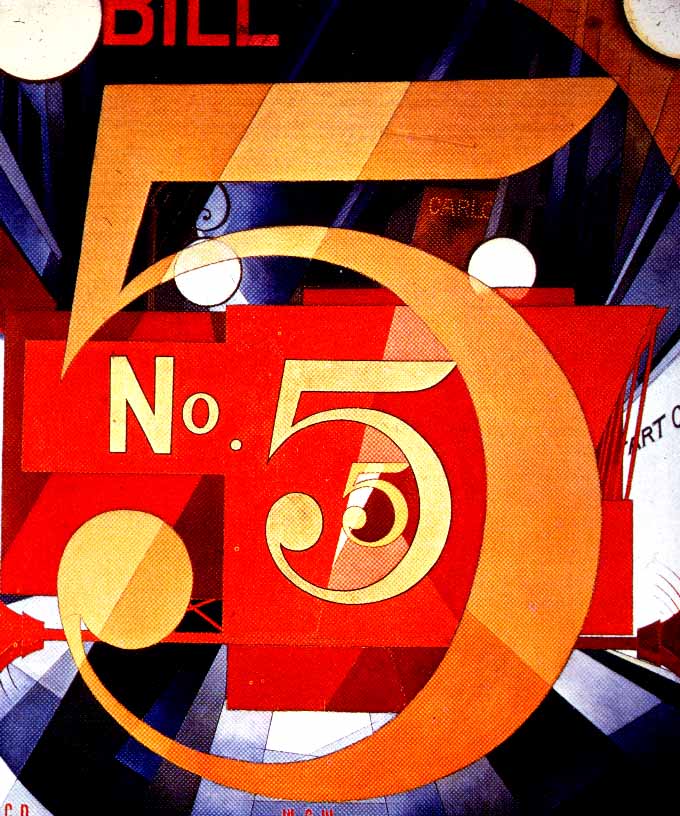
Today's American Masterpiece takes its inspiration from William Carlos Williams' 1921 poem "The Great Figure."  

                                                        The Great Figure
Among the rain
and lights
I saw the figure 5
in gold
on a red
fire truck
moving
tense
unheeded
to gong clangs
siren howls
and wheels rumbling
through the dark city
William Carlos Williams (1883-1963)
Sour Grapes: A Book of Poems
Four Seas Company, Boston, 1921

Williams was a friend of the Precisionist painter Charles Demuth.  Precisionism could also be referred to as "Cubo-Realism."  It's a descriptive form, propelled by geometric simplification.  Precisionist works are usually stripped of detail and tend to be based on sharp-focus photography.  Along with fellow Pennsylvanian Charles Sheeler, Demuth was the major figure in the American-based Precisionism.

During the 1920s, Demuth began a series of abstract portraits of American artist-friends (including Eugene O'Neill, Georgia O'Keeffe, Wallace Stevens).  The portraits were not physical resemblances, but rather paintings that contained images associated with the respective artists: words, phrases, shapes, figures.


In Demuth's work, we see fragments of the Williams poem: wheels, the gold '5', the sense of motion, lights, what may or may be not be the bulky body of the fire truck, the blackened night.  We even see bits of the poet's name: 'Bill,' 'Carlo...'
Williams' own inspiration for his work was seeing a fire truck rush past him on Ninth Avenue in New York City on a hot summer day.
Here's a link to the painting (and commentary) from the MET's website: http://www.metmuseum.org/toah/works-of-art/49.59.1